Understanding Early Exploration
Exploration projects produce nothing, generate no revenue, and own few, if any, physical assets beyond their exploration licences. So how does one put value on an exploration project?
As an investor, you might have come across terms such as Mineral Resources and Ore Reserves. These describe progressively better understood and more economically constrained quantities of mineralisation and are among the most important pieces of information used when assessing a mining project's value. But every mineable deposit began at a much earlier stage.
Indeed, in an early-stage exploration project, the company may not have a Mineral Resource or Reserve at all. So, if no deposit has yet been defined, what exactly are investors buying?
The answer lies in the potential for a discovery. Rather than looking at what the company has already found, investors look for clues that suggest where a deposit might be and how likely the company is to find it. Early exploration is therefore fundamentally a process of reducing geological uncertainty: each stage produces new information that either strengthens or weakens the case for a potential deposit.
After all, before a Mineral Resource can be estimated, the mineralisation must first be discovered. Knowing what to look for in the early stages of exploration is thus important for understanding how these companies are valued.
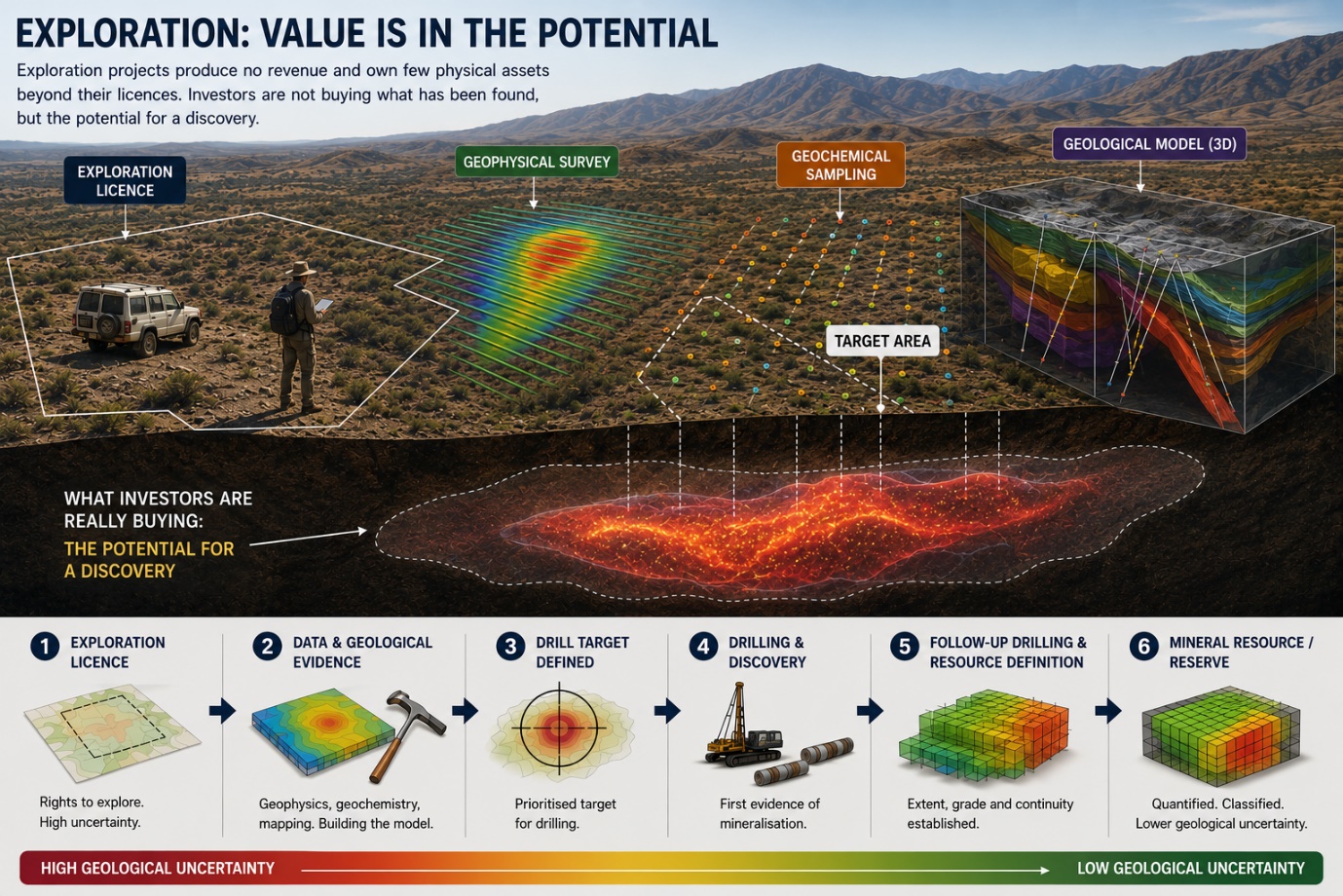
From geology to an exploration target
So how does a project with nothing but an exploration license eventually get to having a Mineral Resource? The process usually begins with a combination of geological knowledge, existing data and initial exploration work.
Firstly, geologists identify an area with the potential to host the type of deposit their company is looking for. They consider the regional geology and what is already known about the area, including previous exploration data, known deposits in that area, and the geological processes that could have formed the deposit. This allows them to develop a geological model of what a potential deposit might look like and, importantly, where the conditions required for its formation may occur.
Once such an area has been found, the explorer then collects more data about the area through geophysics and geochemistry.
Geophysical surveys include magnetic surveys, gravimetry, electrical conductivity, radiometry and seismic imaging. These surveys reveal changes in the earth's subsurface properties, which can indicate rocks, structures or mineralisation related to the presence of ore deposits. Geochemical surveys provide another layer of information wherein surveyors look for unusual concentrations of elements in soil, stream sediments or rock samples, which are used to determine mineralisation potential. Together, geophysical and geochemical surveys help to identify areas of interest and generate the initial exploration drill target.
Initial Drilling
Neither geochemical or geophysical results alone can be used as definitive evidence that a deposit exists. The next stage of exploration is therefore to test the geological hypothesis directly through drilling.
Using the data from geochemistry and geophysics, geologists pinpoint specific locations for drilling that would maximise the likelihood of hitting the ore deposit itself. Drilling involves using a specialised rig to penetrate the ground and bring material from beneath the surface back to the surface for examination and analysis. At this early stage, explorers often use reverse-circulation (RC) drilling, which breaks apart the rock into chips which are returned to the surface. This is cheaper than diamond drilling and suitable for this stage. These samples are logged by geologists and analysed to determine the rock types, alteration and mineralisation encountered at different depths. The rock chips thus provide physical samples of the rocks beneath the surface, allowing geologists to determine key features such as structures, alteration and mineralisation, and to compare with their model.
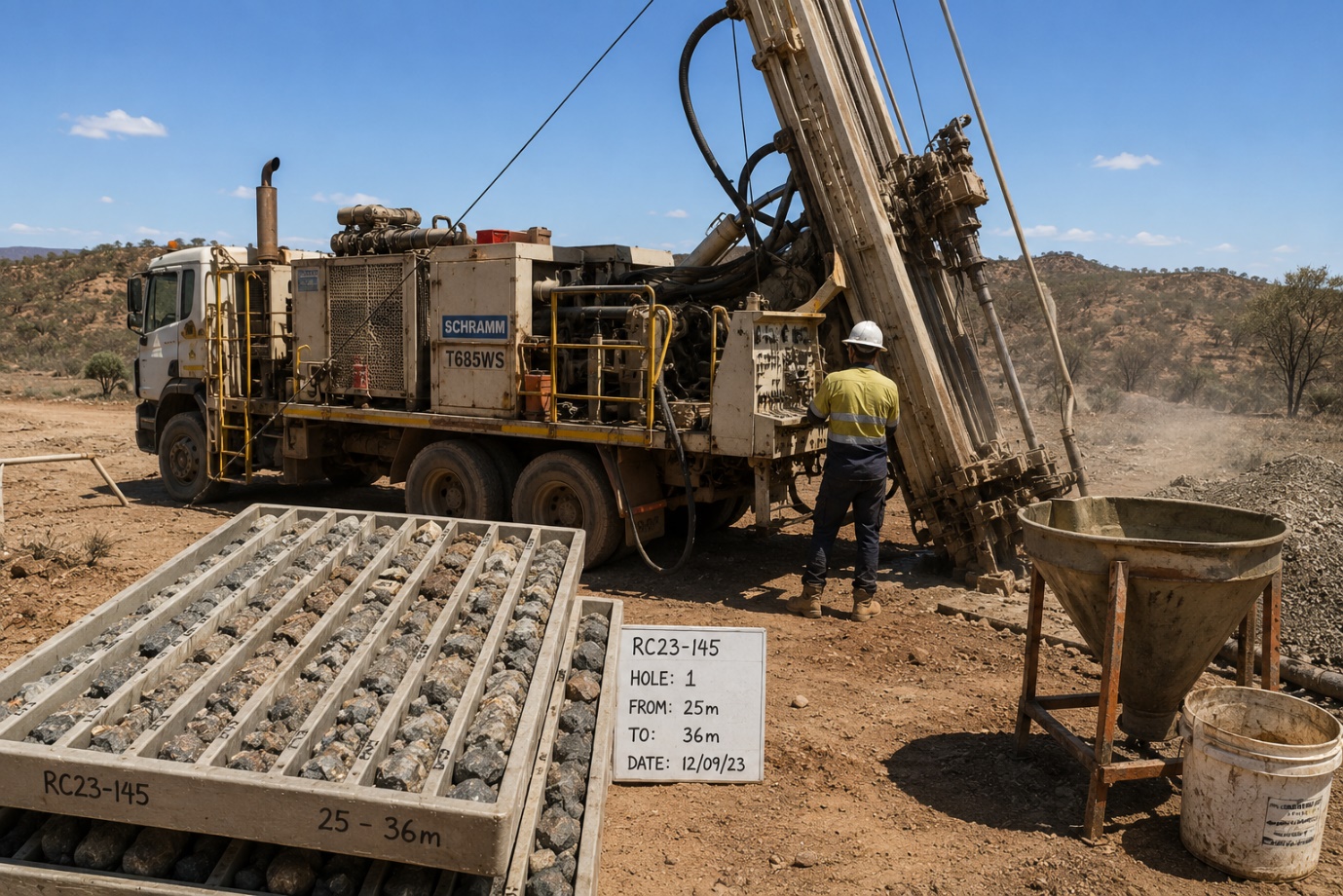
The drill hole may encounter nothing of interest. It may encounter the expected geology but no significant mineralisation. It may intersect weak mineralisation that supports the geological model but is unlikely to be economically important. Or, in the best case, it may intersect significant mineralisation.
The first drill intercept
This is perhaps the first major milestone for any exploration company. Before this point, investors are essentially investing in a geological hypothesis: there may be favourable geology, promising geochemical anomalies and compelling geophysical signatures, but there is no direct evidence of an orebody. For the first time, the market has physical evidence that the target contains mineralisation, and the project may begin to attract substantially greater attention from investors. A strong result increases investor confidence and makes it easier for the company to raise further capital needed to continue drilling and determine whether the discovery extends beyond the initial hole.
Investors will look at factors such as the length of the mineralised interval, its grade, the type of mineralisation, and how it compares with the company's expectations, original geological model and nearby deposits. A strong intercept can materially increase confidence in the project's potential, attract new investors and substantially improve the company's ability to raise capital for further drilling and exploration. For some junior explorers, this can represent the first major step in the process of creating value from the project and may open the door to a much larger pool of capital.
However, the company still needs to demonstrate that the mineralisation is sufficiently large, continuous and high-grade to have economic potential. Until this is established, a spectacular drill result remains an indication of potential rather than proof of a mineable deposit.
Follow-up drilling
Once mineralisation has been established by initial drilling, follow-up drilling is conducted to establish the extent, size, shape, structure and grade of the mineralisation.
Drill holes are positioned around the original intercept to test the mineralisation along strike, across its width and at depth. As more holes are completed, geologists build a three-dimensional model of the mineralised zone and assess its continuity.
At this stage, companies may use diamond drilling alongside RC drilling to obtain diamond drill cores, as continuous cylindrical samples. Diamond drilling is the gold standard for structural observation since it preserves the structure and relationships between different rocks. Geologists examine the cores carefully, logging lithology, structures, alteration and mineralisation, while samples are sent for laboratory assay to determine their grade.
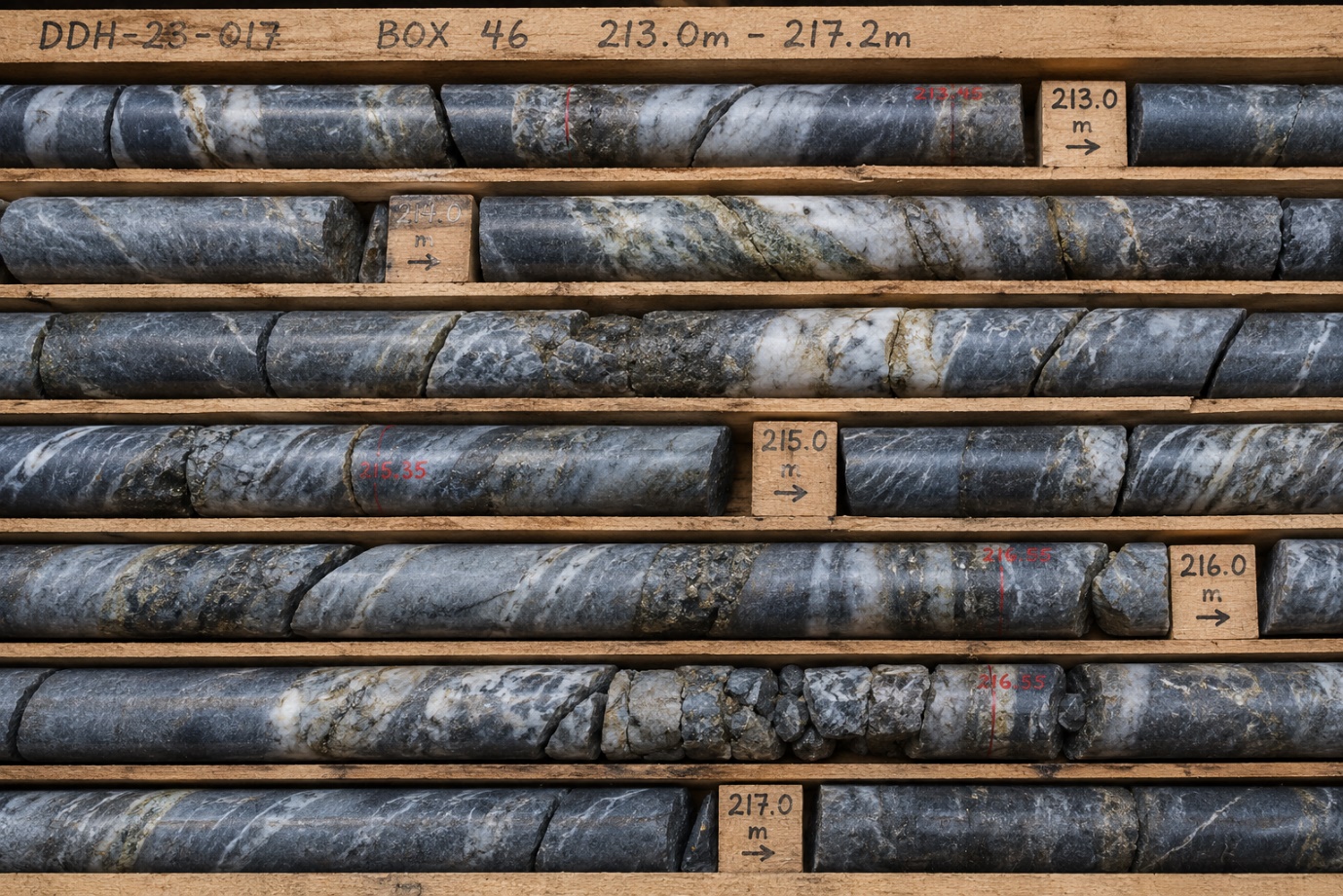
If indeed the drilling confirms continuity of the mineralisation, the company can begin to define the discovery.
Defining the discovery
Once follow-up drilling has established sufficient continuity and geological information, the company can begin defining the discovery. Geologists build a 3D model of the mineralised zone using the drill results, geological observations and assay data. This model is then used to estimate the volume and grade of the mineralisation within the defined area.
This result is known as a Mineral Resource Estimate, which reports the quantity and grade of mineralisation, and is classified based on the level of geological confidence. This is another highly significant milestone for an exploration project. With an actual defined resource, investors have a clearer basis for valuing the project than before, and the company can now seek significantly more capital to expand the resource by conducting additional drilling, metallurgical and economic development, or mine planning. This is the stage where a broader investor base actually becomes accessible and companies may consider an IPO or listing at this stage.
How exploration companies create value
To answer the question posed at the start: exploration companies do the essential task of reducing uncertainty of potential mineral deposits, thereby creating value. Early on, the project is supported only by geological evidence and nearby deposits, and as exploration progresses, geophysical and geochemical results provide stronger targets, drilling confirms mineralisation, and follow-up drilling establishes its extent and continuity. Each successful stage increases the market's confidence in the project and, in turn, its value.
This creates a cycle of capital → exploration → discovery → re-rating → further fundraising → resource definition → potential development or acquisition. The key point for investors is that value is created not simply by spending money on exploration, but by generating better geological information and demonstrating that the project has greater potential than previously understood.
For a junior explorer, a successful discovery can therefore have an effect far beyond the value of the mineralisation already identified. It can attract new investors, support larger capital raisings and bring the company to the attention of larger mining companies looking for new projects. Conversely, failed drilling can reduce the perceived value of a project and leave the company needing to find a new target or raise capital on less favourable terms.
Many investors ask the following: Which stage of early exploration to go in?
It is heavily dependent on the risk appetite and technical expertise of individual investors and investment committee. Every stage has a balance of risk, valuation and return.
Every project starts from an exploration license, then a geological model, then a drill target from some supporting geophysical or geochemical evidence. At these stages, valuation is based on the perceived probability of a discovery and the quality of the exploration ground. Therefore, the upside is highest at this stage, but so is the risk of failure.
Once a successful drill intercept occurs, it can produce a sharp increase in valuation because the market now has direct evidence that mineralisation exists. The size of the re-rating depends on the quality of the result, the scale of the target and how the result compares with what the market had already expected. This means that a single strong intercept can create a large increase in value even though the company may still have no Mineral Resource and may need to raise substantial amounts of capital to continue drilling.
If follow-up drilling establishes continuity and the company gets a true Mineral Resource Estimate, geological risk falls further, and the project is rerated again at this stage since confidence in the quantity and quality of the mineralisation is higher. The potential upside from the current valuation may be lower because some of the discovery risk has already been removed, but so is the risk of geological failure.
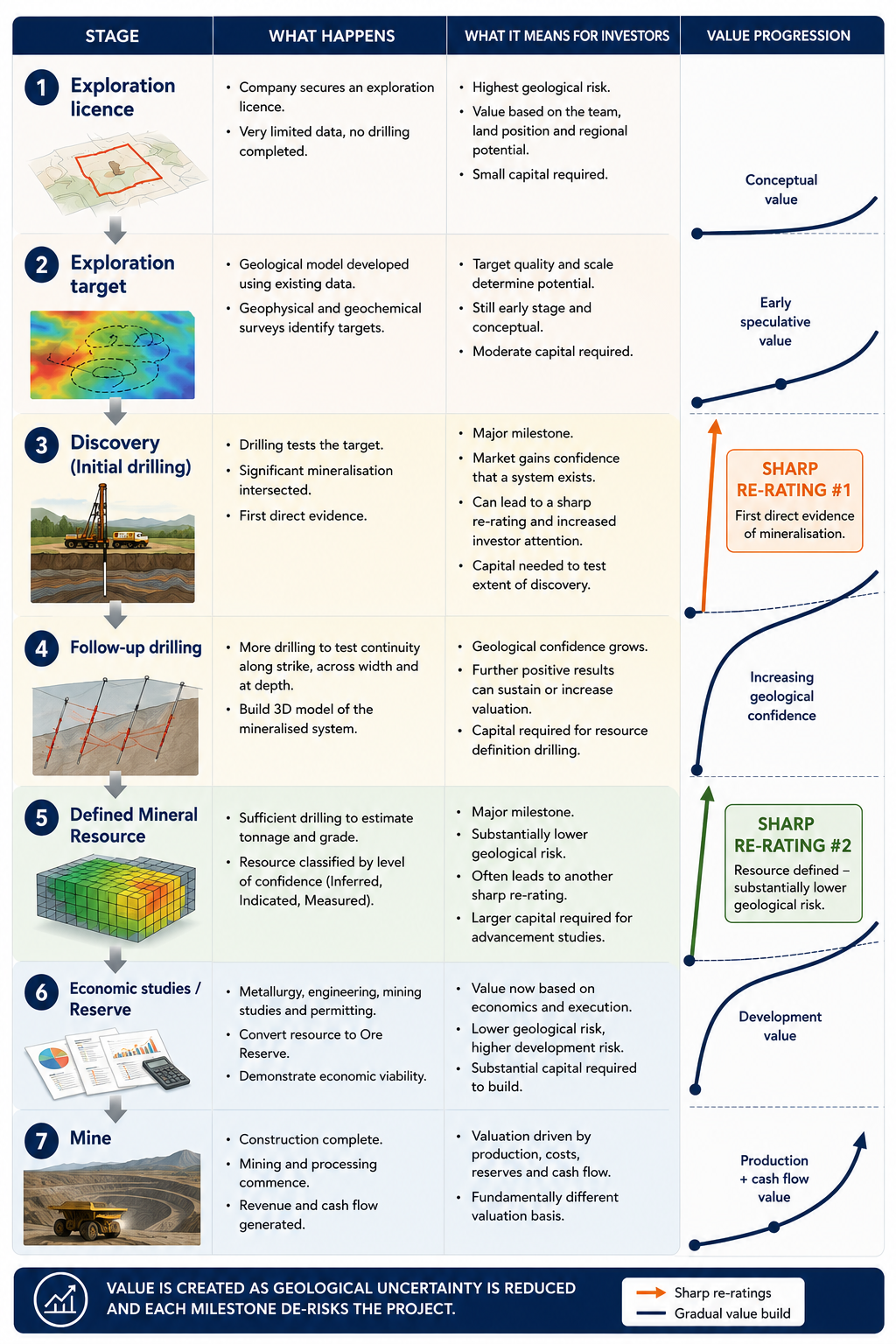
Besides understanding where the project lies on the risk curve, it is vital for investors to look beyond the headline valuation and consider how much capital is required to reach the next stage. A company with a $20 million market capitalisation may appear cheap, but if it needs to raise a further $15 million to complete its next drilling programme, existing shareholders could face significant dilution. Conversely, a company with a $100 million valuation and a defined Mineral Resource may carry much less geological risk, but much of that de-risking would likely already be reflected in its share price.
The same principle applies as the project advances. Moving from a geological concept to an exploration target is relatively inexpensive, with costs rising significantly once drilling begins. Follow-up drilling to define a Mineral Resource requires a much larger and hence much more expensive exploration programme. Advancing from a Mineral Resource towards a mine is more capital intensive still, requiring expenditure on metallurgy, engineering, environmental studies, permitting and economic assessments, followed by the construction of the mine itself. The capital required therefore increases by orders of magnitude as a project advances, while geological uncertainty falls, but not at an exactly comparable rate.
The key questions at each stage are therefore:
- What has been proven? How much geological uncertainty has actually been removed?
- What is the next milestone? What result could materially increase the value of the project?
- How much will it cost to reach it? How much capital does the company have, and how much more will it need to raise?
- How much of that success is already priced in? Is the current valuation reasonable relative to the project's remaining risk and potential upside?
Ultimately, the most attractive exploration opportunities are not necessarily those with the largest resources or highest-grade drill results. They are the projects where the next stage of exploration has the potential to create substantially more value than the capital required to reach it, and where that potential is not yet fully reflected in the company's valuation. But project quality is only part of the equation. Commodity market outlook and long-term price forecasts is equally important in determining junior mining companies' valuation.